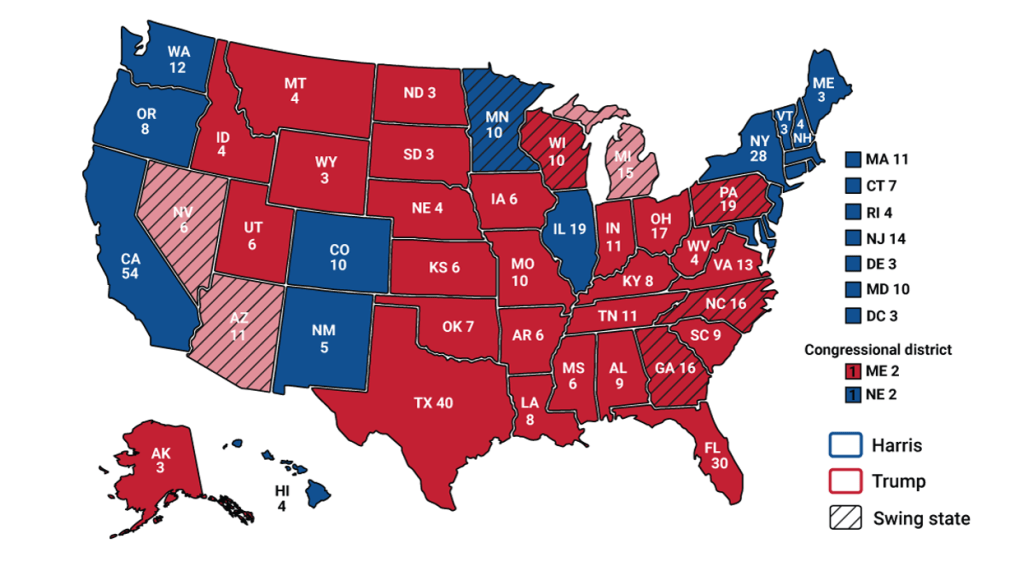
This last November 5th, Americans chose Donald Trump to serve as their 47th President. This happened in a complex environment, where the unexpected twists and the underlying, hidden dynamics of the race were key. Very deep, insightful analyses will be carried out, but under no circumstances will you find any of them on this website.
This is not due to yours truly going through a prolonged bout of depression to do the result (surprisingly, I’m doing alright) or because there is nothing left to say about how it all shook out (there is still low-hanging fruit most people haven’t gotten to, I think). Instead, it’s a purely personal, long-term decision. I’m not going to write about this election or, really, probably any election in the upcoming year, mainly because I do not plan on following them.
To my esteemed readers (so basically just my friends and family), this will surely come as a shock. Maybe it will even seem inconceivable. Electoral politics has been a key part of my interests for the last ten years, which is both half of my life and basically the entirety of the time I’ve been wise at all. But this abdication is the end of a long process, one which has been in motion since way back when. I didn’t see it until now but, in retrospect, it seems obvious that it would happen like this.
Let me explain: my political awakening came at a much earlier age than most. Nowadays, most people get politically educated in late adolescence or early adulthood, but I started my journey at the tender age of 10. The rise of Podemos in Spain changed everything about how I saw political life. What had always seemed like a cold and distant world had suddenly be one much closer, almost universal. I didn’t know it then, but this is what decisively paved the way for me to arrive where I am today.
Truth is, my experience wasn’t that weird. Okay, maybe it was weird among the cohort of 10 year old boys. But, in a wider sense, institutional politics commands a lot more attention today than before the populist revolution of the last decade. In Spain, the canaries in the coal mine were Iglesias and Abascal but, really, basically every country has had a figure like this: Trump in the US, Bolsonaro in Brazil, Milei in Argentina, Le Pen in France, Corbyn in the UK… the list goes on and on. They are united by their desire to motivate and mobilize dissafected voters into political life because, regardless of what their ideologies may be, all of their projects benefit from the electoral support of that group through the same brand of dissafected populism.
I don’t think I need to remind anyone how all of those stories end. In every case, the arrival of this brand of populism has meant a credible threat to democracy and, in the worst cases, its effective erosion. Contrary to what I would have argued half a decade ago, the universalization of institutional politics hasn’t bettered the public’s political education; it has brought the level of political discourse lower than most of us have ever seen it, into the depths of cynical, sociopathic mud-slinging. Politics not as a way to mediate conflicts in society, but as a huge football match, a sort of pretend war. The very systems designed to minimize polarization and creeping tensions have been turned on their heads to incentivized them.
This political ubiquity is killing us, both as a society and as individuals. Political junkies have always existed, but they (we) used to be regarded as miserable moral zealots. Of course, no one says this anymore, because we’re all political junkies now. No one is allowed to not have an opinion on the President. Likewise, no one is allowed not to have an opinion on their political opposition, something to paint them all, millions of people, with the same broad brush, a prejudice based on ideology when, in reality, ideology is only about framing the same world that we all live in.
That is why I say this without a hint of irony: we need to get fewer people to vote. Way fewer. We must channel that negative energy into other, less destructive pretend wars (like sports). Politics eats us from the inside because we know it’s important, but a lot of people don’t have the ability to take it seriously or as anything more than a tribal war. The inclusion of this group into the electorate is a persistent, dangerous obstacle on the path to a better tomorrow.
When it comes to me, well, I think I should practice what I preach. I’ve spent the last decade of my life prioritizing electoral analysis over everything else, even at times where I have felt no motivation to do so. Since I’m good at it, I almost felt like I had to do it, and I think I’ve come to understand it for what it’s been for years: a cycle of avoidance and self-harm. I have reached the age of 21 with a very reduced friend circle and an ever-decreasing number of deep, meaningful connections with others, and I have used this hobby as a way to escape from all that, and as en excuse. I don’t like talking about it privately or publicly, but (insofar as they’re different things at all) I’m certain I have Social Anxiety Disorder and Avoidant Personality Disorder, and this interest of mine has been key in neither of them ever getting better because of how easy it has made it to cocoon. Now, I must leave all of this behind. My attempts to corner happiness where I wanted it have, unsurprisingly, failed. I’m leaving to look for it, wherever it may be.
To those of you staying in the world of constant analysis, I wish you all the best. I know it’s a really tough hobby, the time and energy investments make it so that it’s basically like having a job but, if you’re passionate about it, it’s so hard to give it up. I’ll just say that I hope you hug all of the people who love you long and often. Go on walks, listen to albums. Presidents come and go, but only your life is fully yours. Cherish it. Look after it. It will end for all of us one day.
See you in the averages.

 Ale's blog